

“It’s just not for me!”
How many times have you said something to that effect to write off an entire genre of games? I know I have. I’m still haunted by the experience of trying to play Dota 2 for the first time, only to be yelled at by my team for not immediately understanding its multitude of nuances. My hasty takeaway at the time was that MOBAs, as a whole, probably weren’t my thing. I’ve had similar instincts about the extraction shooter for the past few years. The careful and cutthroat nature of games like Escape from Tarkov felt inherently at odds with the kind of fast and fun shooters I tend to enjoy. They just weren’t for me.
And yet, here I am impatiently waiting for my work day to end so I can load up Marathon.
Bungie’s new extraction shooter got its hooks in me in a way that no game like it has before. I’m in multiple Discords dedicated to finding squadmates. I’m watching its ARG components unfold like a hawk. I’m even obsessing over in-game lore when that kind of storytelling usually puts me to sleep. After two weeks, Marathon is instilling a valuable lesson in me. There’s no such thing as a game genre I don’t like; all it takes is a game that puts what I’m doing in the right context to win me over.
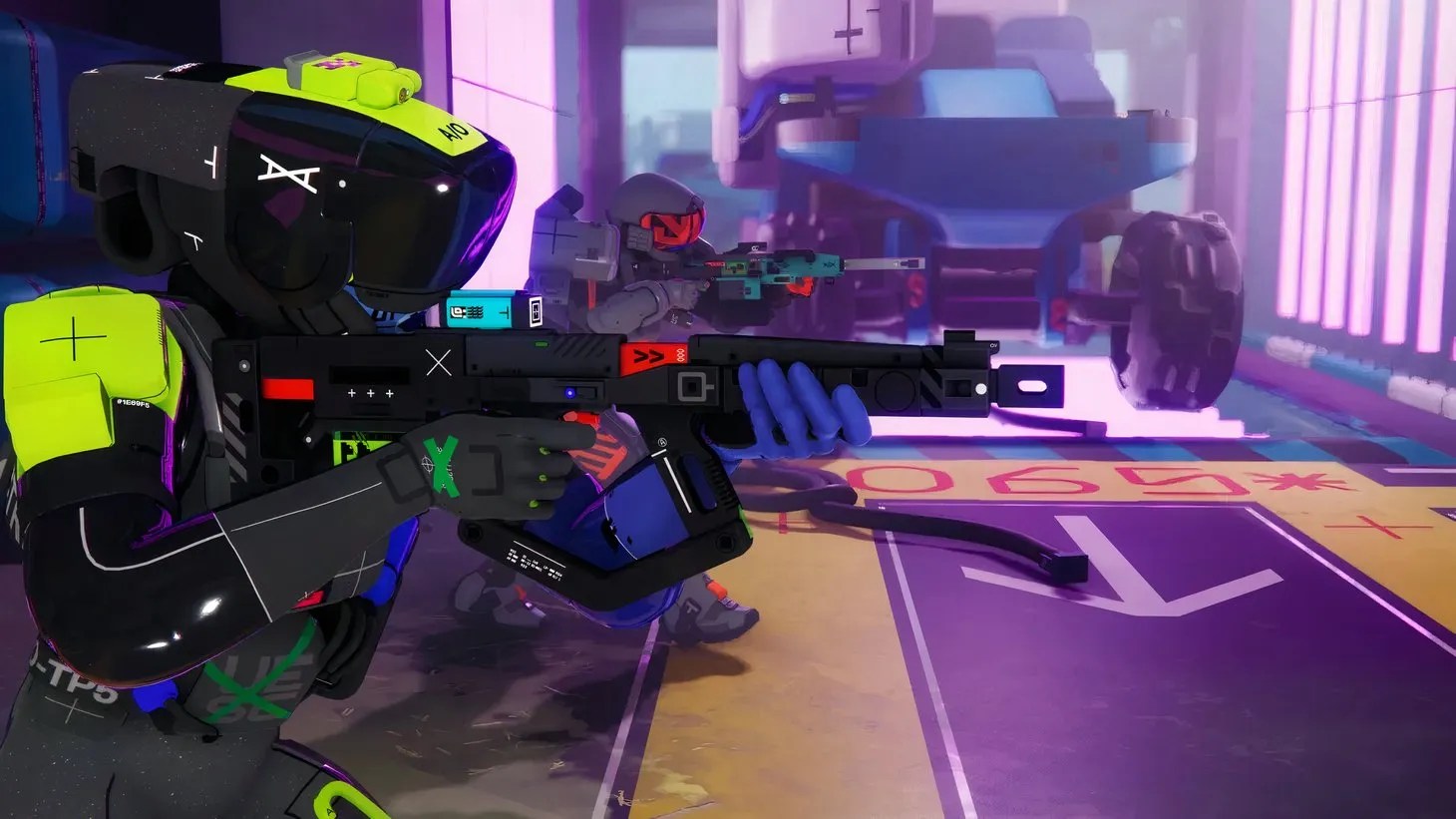
Marathon works the same as many of its genre peers. Players take on the role of Runners, undying mercenaries who are dispatched to the planet Tau Ceti IV to retrieve valuable materials on behalf of warring factions. In practice, that means dropping into a hostile environment, picking up as much loot as possible, and successfully escaping without getting killed by computer-controlled robots or other players who are out to steal your stuff. It’s tense, competitive, and often ends in runs where you lose everything.
On paper, it sounds identical to last year’s hit Arc Raiders. It is in some ways, but there’s a major difference: Marathon is not friendly. Where Arc Raiders fostered a surprising community of peaceful players who wanted to coexist with their neighbors, you will usually get shot and killed on sight the second you are spotted by an enemy in Marathon. Everything, and everyone, on Tau Ceti IV wants you dead.
That difference in dynamic isn’t an organic accident. Marathon is filled with laser-focused design choices that guide players towards hostility. Chief among them is that the main progression hook is less about grabbing gear and more about completing contracts for faction vendors. You’re often tasked with downright cruel mini-quests while out on a run that require you to ruin another player’s day, like finishing off a downed foe instead of giving them a chance to crawl away. Doing so nets you a shower of rewards, like shiny new guns or credits that can be spent on skill trees that in turn unlock more gear you can buy from vendors. If you want more stuff, you have to abandon mercy.
And stuff is king in Marathon. Credits are more valuable than humans on Tau Ceti IV. An overflowing vault is a status symbol. Your gear is your life, and if someone takes it all from you, it’s like they’ve stolen your soul. In a world where corporations run the show, you’re worth exactly as much as your loadout’s credit value. Popping into a run with a free Sponsored Kit, a sparse starter pack containing one gun and a few grody healing items, feels like an embarrassment. How undignified is it to take charity scraps from a shady pharmaceutical company!
Everything in Marathon is designed to push the limits of your humanity as you struggle to make a decent living…
All of that brings a psychology to Marathon that sets it apart from other extraction shooters I’ve tried. There are high narrative stakes behind all the looting and backstabbing. If I don’t make desperate moves to get the work done, I’m going to be left behind. In a sharp bit of analysis on the game, ReaderGrev’s Mikhail Kimentov identifies Marathon as a darkly comedic satire of the IRL modern gig economy. That read is spot on based on my experience. It’s a game about “get the bag” culture, and the lengths we’re willing to go to in order to survive. Everything in Marathon is designed to push the limits of your humanity as you struggle to make a decent living at the expense of people who are more powerful than you’ll ever hope to be.
It’s that narrative grounding that has sucked me into Marathon, though it took me a few rounds to fully get there. I spent my first days with it wondering what the point of it all was, just as I have in other extraction shooters. Why fill up my inventory with all this assorted junk? Just so I have a better chance of getting more junk next round? It’s a cyclical loop that begs for some extra motivation in games like this. If you can’t make a convincing case for why I should care, I’m not going to willingly stress myself out. That’s not just something that’s specific to extraction shooters; it applies to any video game. The magic trick of design is finding a way to make the pretend play you’re engaging in meaningful.
I’m continually finding that meaning in Marathon. The more I embrace the act of role-playing as a Runner in this hostile world, the more I feel the real anxiety underpinning the action. I feel what it’s like to be a cog in the machine. To be tossed around by corporations. To be so desperate for survival that I’ll do anything to make a buck. I don’t need a video game to show me that when I live it every day, but simulation helps me better understand my resentment by deconstructing it in game design terms. My mentality has slowly evolved alongside the game itself for the past two weeks; I’m gradually becoming radicalized in-universe and waiting for the moment where the Marathon community discovers a way to rebel together instead of killing one another. (Though that would require a fairly drastic shift to what Marathon is. Catharsis is hard to come by in a live-service machine built to slow-fade rather than crescendo.)
In its most powerful moments, Marathon even pushes me to be a more empathetic person. In one round, my team moved towards an exfil beacon after gathering a ton of gear. We were met with gunfire from an assailant we couldn’t see. After taking cover in a building and waiting for our ship to arrive, we decided to make a run for it. After all, you can still escape with your gear even if you’re down so long as you’re in the exit radius. We pushed into the departure circle, and I was shot down immediately. Injured, but still capable of escape. Then my attacker threw a smoke grenade on the exfil, ran in, hit me with a finisher, and disappeared without touching my teammates. “Why the hell would someone do that?” I thought. It was a ridiculous level of risk just to screw with me specifically.
A few sessions later, I unlocked a new contract from one of my bloodthirsty faction vendors. I had to perform 10 finishers to progress the quest. I instantly remembered my ruthless killer. Maybe they had that same contract active. I pictured them loading into matches, round after round, struggling to pull off the difficult job. The only way out of that dead end was to risk their own life for a few measly credits. Getting turned into swiss cheese by my vengeful teammates would be worth it so long as they checked a box for the people pulling their strings. Hell, that fate might even have been preferable. At least they would have been punished for their sin rather than stuffing the guilt into their vault.
Or maybe they were just an asshole. Maybe I am too.
- Security Camera Installation – indoor/outdoor IP CCTV systems & video analytics
- Access Control Installation – key card, fob, biometric & cloud‑based door entry
- Business Security Systems – integrated alarms, surveillance & access control
- Structured Cabling Services – voice, data & fiber infrastructure for new or existing builds
- Video Monitoring Services – 24/7 remote surveillance and analytics monitoring
Author: 360 Technology Group