

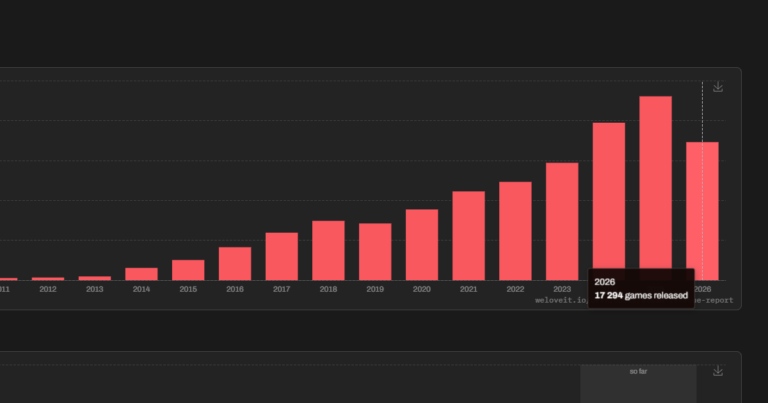
The growing struggle of indie games on Steam contrasts with the ascent of AI in gaming and strategic moves in publishing.
The notable trend emerging from recent developments is the ongoing financial struggle for games on Steam, as highlighted by a striking twelve-year decline in median revenue for titles on the platform. According to a report from GameWorldObserver, the revenue median for games released in 2026 stood at a meager $1,728, reflecting a more than tenfold decrease compared to 2016 figures. This sustained decline presents considerable challenges for indie developers trying to find footing in a market that seems increasingly skewed towards successful established titles.
In parallel, there’s a noticeable shift towards strategic moves in video game publishing. Aggro Crab and Firefly, two game development studios, have launched new publishing initiatives, seeking to carve out niches in the steadily evolving video game market. As reported by Game Developer, Aggro Crab’s label aims to publish “intense, stylized games,” notably excluding projects involving generative AI, while Firefly’s Wuselfaktory, covered by GamesIndustry, intends to cater to the still-thriving strategy genre. Both companies are positioning to navigate around the challenges exhibited by Steam’s financial report by concentrating on established niches and genres with committed audiences.
On the technological front, the use of AI in gaming continues to develop, underscored by efforts from both Arm and EA. Arm introduced its mobile-first AI-reconstruction technology to the market at their Arm Everywhere China event, diverging from the “black box” model seen in NVIDIA’s DLSS 5. The GamesIndustry article underlines different approaches to AI in gaming, influencing future hardware and software developments.
Meanwhile, EA’s integration of generative AI for voiceovers in “NHL 27” suggests an expansion in how AI technologies can enhance gaming experiences, as noted by Game Developer. This shows a potential trend in the use of generative models to improve aspects of game development and content delivery.
Additionally, the mobile gaming sector continues to show its financial might, with GameWorldObserver reporting that mobile game advertising revenue surpassed $12 billion in 2025, highlighting the financial viability of mobile as a dominant gaming platform.
These industry shifts underscore both challenges and opportunities, demonstrating the importance of strategic pivots in publishing and the increasing role of AI technology in shaping the gaming landscape. In a climate where the commercial success of indie games is questionable, developers and publishers are tasked with finding innovative ways to engage and monetize their audiences.