

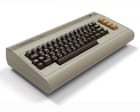
The emotional hit was something I didn’t expect, although perhaps I should have. The Commodore 64 Ultimate, a new version of the legendary 8-bit computer, comes in a box designed to resemble the original packaging – a photo of the machine itself on a background of deep blue fading into a series of white stripes. Then when you open it, you find an uncannily accurate replica of what fans lovingly referred to as the breadbox – the chunky, sloped Commodore 64, in hues of brown and beige, the red LED in one corner above the row of fawn-coloured function keys. It’s like 1982 all over again.
My dad bought us a C64 in late 1983. It was our second computer after the ZX81 and it felt like an enormous leap into the future with its detailed colour graphics, advanced sound chip and proper grown-up keyboard. We unpacked it on our dinner table, plugging it into a small portable TV and loading the one game we had, a very basic Donkey Kong clone named Crazy Kong. My life would never be the same again. This contraption was my obsession for the next four years – my friendships and free-time would revolve around games such as Bruce Lee, Paradroid and Hyper Sports. To this day, I treasure the memories of playing golf sim Leaderboard with my dad. The sound effects, speech samples and graphics conjured by that computer have lived rent free in my head for, god, almost 40 years.
But it’s not just a machine for playing old games. Turn it on using the authentic power switch on the side and it boots into the original Commodore 64 start screen, complete with the words, “Commodore 64 Basic V2, 64K Ram system, 38911 Basic Bytes free. Ready.” And the flashing cursor. You can programme it just as you could back then, using Basic or, if you’re feeling advanced, assembly language. Obviously I tried everyone’s first program in the 1980s:
10 print “keith is cool”;
20 goto 10
It worked. After that, I dug out an old program listing from Computer & Video Games magazine and have been typing it in – although it’s a challenge as the print is small, faint and smudged after 30 years in my attic. On top of this, you can click the power button upwards and it switches to an alternate menu crammed with new options. You can plug in a USB thumb drive and load C64 games and apps that you’ve acquired online. The computer also comes with a sample USB drive (shaped like a cassette tape) that is filled with demos and games to try. Even better, it’s easy to connect it the internet via a wired or wireless connection, which gives you access to a community archive of games, as well as old school bulletin board systems, basically the 1980s equivalents of Reddit forums.
What I love about the machine is this seamless integration of modern tech into a retro environment. You can plug it into a modern monitor via HDMI, but the menus and inputs are all redolent of the 1980s era – lists of text, Ascii art, cursor keys or W, A, S, D for navigation. The memories of interacting with this ancient hardware came flooding back. Everything you did on the C64 required some effort and expertise, whether that was loading a game or writing little programs – there was no drag-and-drop, no plug-and-play; you were a computer user not a platform consumer. In its press release announcing the product, Commodore referred to itself as “the Digital Detox Brand – a bold stand against today’s toxic tech”. And while that’s a little polemical and self-aggrandising, there’s some truth in it. Exploring the C64 these last few weeks has given me more pleasure than downloading an app on to my phone ever has.
Set to be priced at £260.50 ($349.99/AU$524), it’s not cheap and begs the question – is there value to this machine beyond its appeal to original owners? I think there is. In a more accessible way than the incredible PDP-10 replica I wrote about last year, it’s a living historical relic, a way to reconnect with the original concept of a desktop home computer – as something we learned and coded for. The excellent user’s guide it ships with is filled with useful information on how to get it to make music and display graphics; I sincerely hope that an alternative indie gaming scene thrives here as a result. There is intrinsic value in understanding computers at a fundamental level beyond slick user interfaces; there is value in developing a knowledge of how programs work, however simple.
And even the machine’s nostalgic impact has worth. It has been fun to show my sons this fossilised contraption – no curated walls of games to buy, no ads, no pop-ups, no social media notifications. Meanwhile, playing those old games again has proven the value of great design and clever programming over hype and visual impact. It’s a lesson we could all afford to learn.
- Security Camera Installation – indoor/outdoor IP CCTV systems & video analytics
- Access Control Installation – key card, fob, biometric & cloud‑based door entry
- Business Security Systems – integrated alarms, surveillance & access control
- Structured Cabling Services – voice, data & fiber infrastructure for new or existing builds
- Video Monitoring Services – 24/7 remote surveillance and analytics monitoring
Author: 360 Technology Group


![Telltale-Like Star Trek Game Is Getting Pulled From Sale Forever [Update]](https://i0.wp.com/kotaku.com/app/uploads/2026/04/sad-spock-1280x720.jpg?ssl=1)


