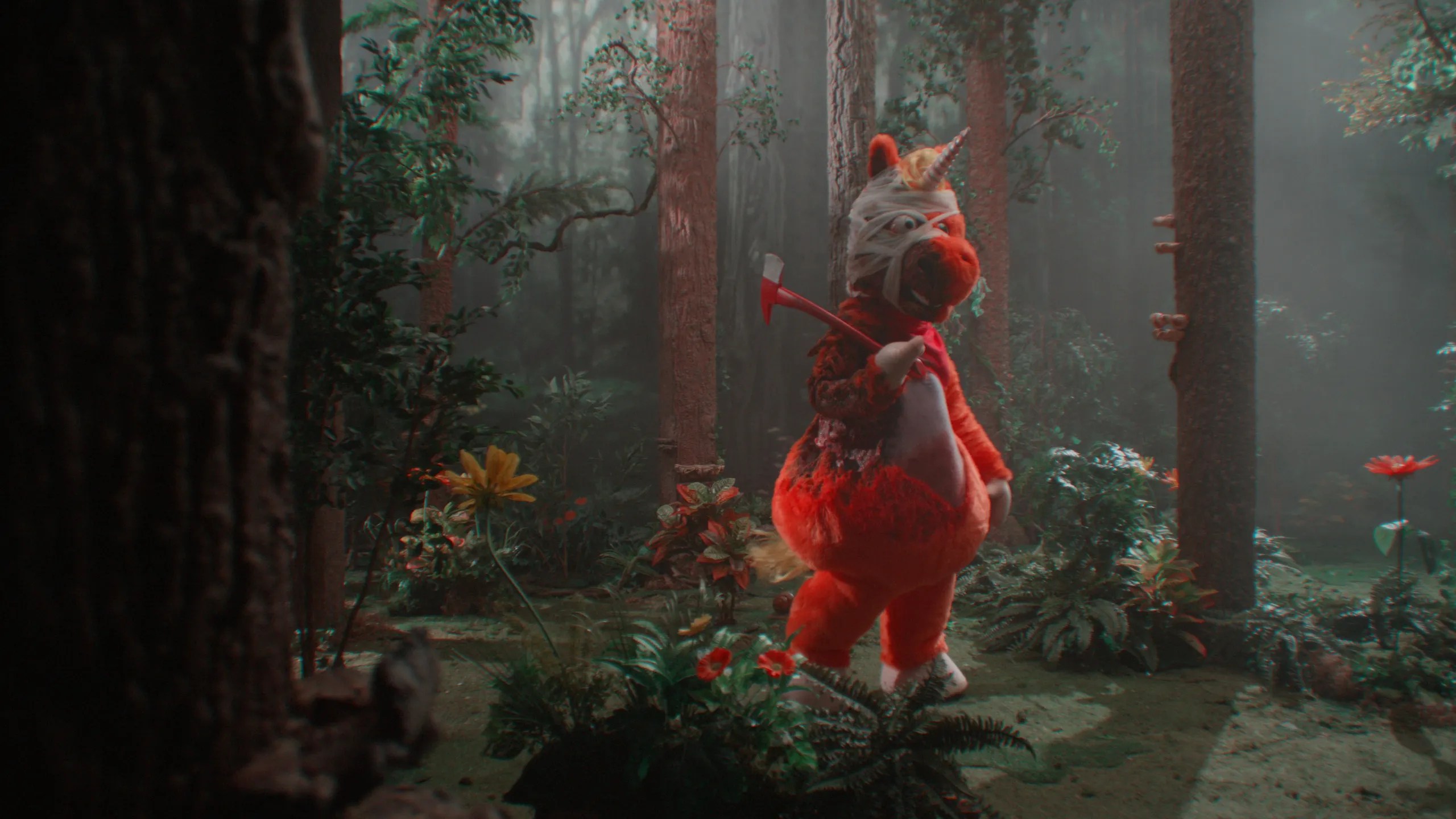


Matthew Robinson still remembers the time he asked his friend, Doug Liman, the director behind action classics like The Bourne Identity, Mr. and Mrs Smith, to read the script for Good Luck, How Fun, Don’t Die. Robinson previously rewrote Liman’s hit Tom Cruise time-loop movie Edge of Tomorrow. Now, he was presenting the acclaimed filmmaker with his own take on the genre.
“You kind of wrote Edge of Tomorrow 2,” Liman said. Robinson couldn’t help but agree.
Robinson’s still hoping for an actual Edge of Tomorrow 2 — “I don’t care if it’s mine,” he tells Polygon, “I’ll take anybody’s sequel” — but in the meantime, Good Luck is pretty damn close. Out on Feb. 13, the movie stars Sam Rockwell as a quirky, disheveled man who bursts into a Los Angeles diner one night claiming he was sent from the future to avert an AI apocalypse. This unnamed time traveler is also stuck in a loop of his own, attempting to save the world over and over until he succeeds. Robinson’s script, this time in the hands of director Gore Verbinski (Pirates of the Caribbean, The Ring), tracks one of those attempts from beginning to end, while taking several detours to fill in backstories for the rest of the cast, which includes Juno Temple, Michael Peña, Zazie Beetz, and Haley Lu Richardson.
In addition to its Edge of Tomorrow influences, Good Luck, How Fun, Don’t Die borrows liberally from The Terminator, 12 Monkeys, and other classic sci-fi. In an interview via Zoom, Robinson doesn’t shy away from those similarities. He wants you to pick up on those connections as you watch the film, while also pushing some buttons with techno-dystopian horror straight out of Black Mirror.
“I am not afraid of showing my inspirations hard on my sleeve,” Robinson says.
Ahead of Good Luck’s release, Polygon spoke to Robinson about the origins of his script, what Verbinski added to the movie, and the controversial plotline he refused to take out.
This interview has been edited and condensed for clarity.
Polygon: Where did the idea for this movie come from?
Matthew Robinson: I had a bunch of small, not movie-worthy ideas about technology. The Michael Peña-Zazie Beetz storyline about substitute teachers in a school where the kids are slowly becoming zombies was a pilot that I wrote. I was trying to write The Breakfast Club from the teacher’s perspective, where the teachers are the rebels and the students are the conformist zombies. It was fine, but it wasn’t a movie. It was 20 minutes. I had this other idea about virtual reality and gaming that I really liked.
And then I was in a Norm’s Diner one night. I looked around and saw everybody on their phones. I had this thought: Is there somebody who could walk in right now and convince us to stop? And then I challenged myself to find a fun way to take these disparate ideas that are all linked by theme and tell one fun, one-crazy-night kind of story. I was inspired by Canterbury Tales, which is sort of one long journey where we push in and get these origin stories of the people on the journey.
Good Luck has a lot in common with Terminator. Was that intentional?
I leaned into it as hard as I could. I like writing what I’m influenced by. I don’t feel like I’m ever being lazy or stealing. To me, it’s always building on top of something I love. And instead of trying to obfuscate it, I like to highlight it.
We literally reference Terminator a handful of times in the movie, but also there’s a lot of 12 Monkeys. There’s a lot of Akira. There’s a lot of Brazil. There’s a lot of Terry Gilliam in general. I’m happy to dive into those things and shine a light on them to let you know I’m not accidentally doing this. These are things I love, too. And hopefully, if you love those things, you’ll dig the stuff that I want to talk about.
How did the movie change once Gore Verbinski got involved?
He loved the script. We had a very similar vision. We did some work in the third act together; some of the Haley Lu Richardson storyline was played around with a bit. But structurally it stayed the same. The main characters were all there.
The incredible thing Gore added was all of these wild, amazing set pieces, which were not in the script at all. There’s this whole set piece of a car chase in a winding, abandoned mall. None of that’s in the script, and Gore turned it into an amazing action sequence. I would show up on set and be shocked by just some random dialogue scene I’d written that he turned into this amazing set piece with running and jumping and screaming and guns and costumes I couldn’t imagine, and all these little visual jokes in the background. He did what a brilliant director does, which is elevate a script way beyond anything that was on the page.
One of the flashbacks in the movie tells a story about school shootings that’s incredibly dark, but also manages to be extremely funny at times. Were you ever worried it was too intense for what’s essentially a sci-fi comedy?
Yeah, and it’s the reason that we had to make it independently. Every studio in the world said no purely because of that one storyline where it becomes challenging emotionally and morally. And I understand why studios passed on it. A lot of them said, “What if there’s a school shooting the weekend the movie comes out? We’re dead.” And I’d go, “There will be.” This is America in 2026. It’s a nightmare. There’s school shootings every week, and we need to be talking about it. We need to be talking about how insane it is that we’ve normalized gun culture. How insane it is that one school shooting happened, and we didn’t change our entire ethos, that we didn’t change our entire life as a country.
So it’s a very angry part of the movie. I’m very angry about it. I have children. I think about it regularly. It’s affected my relationship with this country: whether or not I want to be here or not, and whether or not it’s safe to be here with my children. There’s nothing funny to me about school shootings, but the only way I know how to digest something is through satire and gallows humor. If something is so impossible to accept for me, I have to laugh at it, because otherwise it will consume me.
So I hope it’s cathartic for people, and I hope it pisses people off in the right way, and I hope they recognize that I am with them in terms of how angry I am about the school shooting situation in this country and how immorally we’ve normalized it.
Good Luck, How Fun, Don’t Die is in theaters starting Feb. 13
- Security Camera Installation – indoor/outdoor IP CCTV systems & video analytics
- Access Control Installation – key card, fob, biometric & cloud‑based door entry
- Business Security Systems – integrated alarms, surveillance & access control
- Structured Cabling Services – voice, data & fiber infrastructure for new or existing builds
- Video Monitoring Services – 24/7 remote surveillance and analytics monitoring
Author: 360 Technology Group